
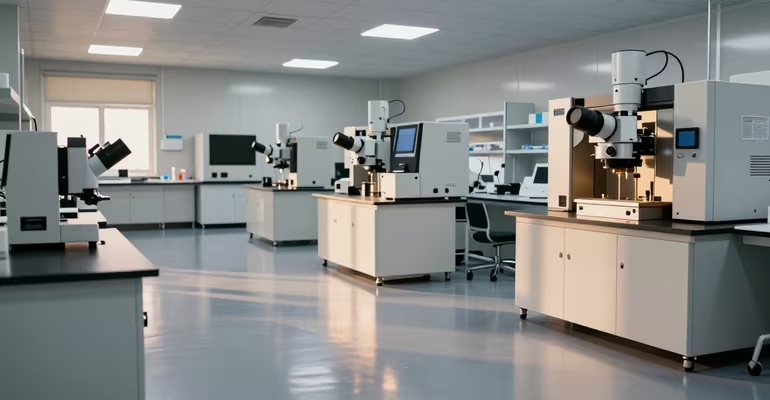
Every step of the energy transition—storing electricity, generating it cleanly, and moving it efficiently—runs into a materials constraint before it runs into anything else. Battery electrode chemistries, catalyst durability, and photovoltaic stability are where the engineering ambitions of decarbonization meet the hard limits of atomic-scale physics and chemistry.
Materials as the bottleneck
Grid-scale energy storage looks like a straightforward engineering problem: build enough batteries to smooth the variability of wind and solar generation. In practice, every storage chemistry trades off energy density, cycle life, safety, and raw-material cost. Those tradeoffs are set almost entirely at the level of materials—the crystal structure of an electrode, the stability of an electrolyte interface, and the degree to which repeated charge cycles cause breakdown.
Generation faces a parallel materials challenge. Perovskite absorbers and tandem cell architectures have pushed laboratory efficiencies upward, but practical deployment is limited as much by long-term stability under heat, humidity, and ultraviolet exposure as by the physics of light absorption. Green hydrogen production runs into a similar wall: catalysts must be durable and abundant enough to scale.
From atoms to systems
The traditional path from a candidate material to a working device—synthesize, characterize, iterate—is slow because the space of possible compositions is vast. High-throughput density functional theory screening and machine-learning models trained on materials databases can predict which compositions are likely to be stable and functional before a sample is synthesized.
That does not replace experimental work. X-ray diffraction, electron microscopy, and electrochemical testing remain the ground truth. The open challenge is closing the gap between a computational prediction and a manufacturable material at the scale an energy system requires. A candidate that performs well in a lab cell does not automatically survive thermal cycling, mechanical stress, and years-long operation.
Where materials science meets energy at INSTAR
INSTAR’s materials science and energy programs are deliberately adjacent. Research on structural and electronic materials informs work on solar energy, storage, hydrogen, and grid systems, while grid economics shapes which materials tradeoffs are worth pursuing. We approach the intersection as an integrated program: synthesis and characterization on one side, machine-learning-driven materials discovery on the other, with neither treated as a substitute for the other.
This work is grounded in publicly accessible data, including computational materials databases, curated experimental repositories, and federal energy statistics, so other researchers can check the same benchmarks.