
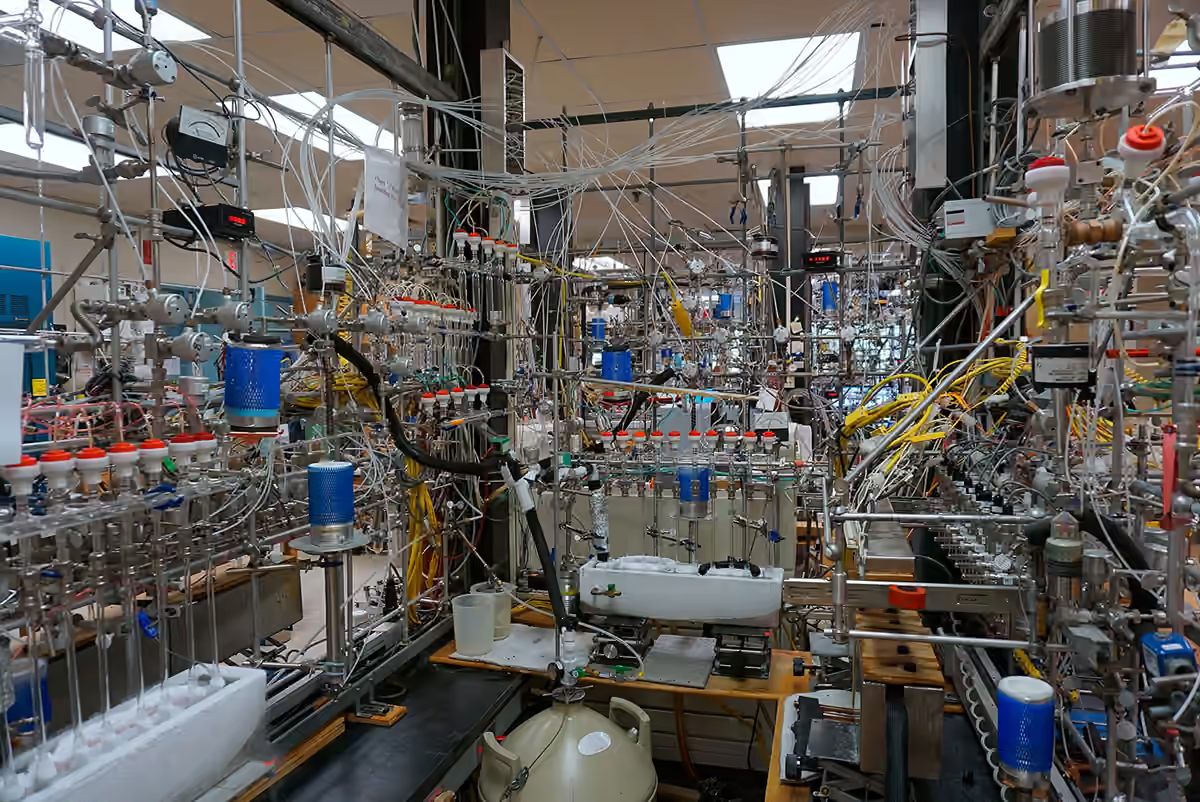
A news story may say that a bone or a hearth has been “radiocarbon dated” to a certain number of years ago. Behind that number sit a measurement, a set of conventions, a calibration curve and a judgement about how the sample relates to the event of interest. Each step adds assumptions or uncertainty.
What the lab measures
Radiocarbon dating uses the decay of carbon-14, a radioactive form of carbon. Plants take in carbon from the atmosphere, and animals take it in through their food. A 2021 review gives the half-life of carbon-14, the time it takes for half of it to decay, as “5,700 ± 30 years,” and says the method is useful for material “formed over the past 55,000 years.”
The lab does not count what the carbon-14 decayed into. The IntCal20 authors explain that “the nitrogen produced by 14C decay is not captured in most materials.” Instead, as a 2004 history published by the National Institute of Standards and Technology (NIST) describes, a sample’s carbon-14 is compared with an agreed “modern carbon” value, and the “radiocarbon age” is calculated using the “Libby half-life” of 5,568 years, an older value that is kept by convention.
The result is a conventional radiocarbon age, written in years “BP,” before present. “Present” is fixed: Stuiver and Polach’s 1977 reporting recommendations state that “AD 1950 equals 0 yrs BP.” The same paper lists what a conventional age assumes, including “the assumption of constancy of 14C atmospheric level during the past.” Carbon-14 in the air has in fact varied, so the age is not yet a calendar date.
Why the age needs calibration
The IntCal20 paper says that radiocarbon ages “must be converted to calendar age equivalents using a calibration curve compensating for fluctuations in atmospheric 14C concentration.” Calibration curves are built by measuring carbon-14 in material dated in other ways, such as tree rings dated to the exact year by tree-ring dating (dendrochronology). IntCal20 is a fully atmospheric record from tree rings back to about 13,900 calibrated years before present (cal BP). Beyond that it also draws on tree-ring sequences not yet tied to exact calendar years, lake and marine sediments, cave formations and corals, back to 55,000 cal BP.
There is more than one curve. IntCal20 is for samples from the Northern Hemisphere atmosphere, SHCal20 for the Southern Hemisphere and Marine20 for marine samples outside polar regions. Comparing tree rings of the same age from the two hemispheres, the SHCal20 authors estimate the mean Southern Hemisphere offset to be “36 ± 27 14C yrs older” than the Northern Hemisphere.
Curves are also revised. The IntCal20 authors write that curves “invariably require revision as new data become available,” and that calibrations with IntCal20 “will also differ from those with IntCal13 for almost all time periods prior to the late Holocene,” the most recent part of the present geological epoch. A paper on the next IntCal and SHCal curves, published in September 2026, says the next set of updates is “planned to be released within the next year.”
Ranges, not single years
A calibrated date is not one year. Because the curve wiggles, a single radiocarbon age can match more than one stretch of calendar time. The IntCal20 authors note that a more detailed curve “may lead to more complex, multimodal calibrated age probability distributions that may require stratigraphic information to resolve.” In plain terms, a date can come out as two or more separate ranges, each with its own probability, and knowing the order of the layers may be needed to choose between them.
Where the curve is nearly flat, many calendar years share almost the same radiocarbon age. The IntCal20 paper calls the Hallstatt plateau, about 800–400 BC, “one of the largest flatter regions in the calibration curve,” and says it has been “problematic” for building chronologies “without adequate stratigraphic control.”
The IntCal20 authors describe the dating of the eruption of Thera (Santorini), in the second millennium BC, as “a contentious issue for Mediterranean archaeology.” Bayesian models using versions of IntCal before IntCal20 had pointed to a late 17th-century BC date, “contrary to some interpretations of the archaeological and historical evidence.” New single-year tree-ring data refined a plateau in this period, which they call “very important for establishing the true possible calendar age ranges.” Calibration models built from the new annual data “increased the probability of a more recent eruption.” They leave what IntCal20 means for the eruption date to other papers in the same issue.
What the date belongs to
A radiocarbon date applies to the carbon in the sample, not to the layer it was found in. Bayliss (2009) puts it directly: “14C dating does not date deposits. It dates organic material.” She advises that samples “must be presumed to be residual (older than the deposit in which they were found)” unless there is evidence or “a convincing argument” that they were fresh when deposited.
Wood is a well-known trap, the “old wood problem.” Kessler (2021) lists three sources of the gap between a wood or charcoal date and its context: “the procurement and use of dead wood,” the recycling of old building material, and the loss of the outermost growth rings. The first two can produce errors “on the order of decades to centuries, or even millennia in exceptional cases”; lost outer rings generally cause errors of years to decades, although Kessler’s own tree-ring data show that ring loss “can span decades to centuries in some samples.” For this reason, Kessler notes, “short-lived organisms or residues are strongly favored” when a date must be tied to a particular human activity.
Reservoir effects
The method assumes that a sample took in carbon in step with the atmosphere. Philippsen (2013) explains that if a sample instead “obtains its carbon from another reservoir with a lower 14C level than the atmosphere,” then “the measured ages can be too old.”
The sea is one such reservoir. Marine20 exists because marine samples “cannot be calibrated directly against the atmospheric-based IntCal20 curve,” and it needs local corrections, called ΔR, that vary by region. Philippsen warns that “the knee-jerk subtraction of 400 years” from marine dates “might be too simplistic in some cases.”
Lakes and rivers can do the same, most often because the water carries dissolved ancient carbonates (hard water). Measuring modern water, plants and animals, Philippsen found that “age differences of up to 2000 14C years can occur within one river,” and that the effect can reach the bones of people who lived on freshwater fish, and pottery in which fish was cooked. Her advice is to consider reservoir effects whenever food remains on pottery or the bones of omnivores are dated, “irrespective of the site’s distance to the coast.” Stuiver and Polach recommended that the uncorrected conventional age always be reported, with any reservoir-corrected age given separately.
Cleaning the sample
Carbon that did not come from the living organism, such as carbonates and humic acids from the burial soil, or chemicals added after excavation, can also distort a date. At the Oxford Radiocarbon Accelerator Unit, Brock and colleagues (2010) describe an acid–base–acid wash “designed to remove sedimentary and other contaminant carbonates, organic acid contaminants such as humic and fulvic acids,” and carbon dioxide absorbed during the base wash. Samples that may hold consolidants (hardening agents), preservatives or other chemicals get solvent washes first. Even so, the authors note: “It can be difficult or impossible to remove many chemical contaminants.” For bone, if the collagen extracted is less than 1% of the starting weight, “the sample is usually rejected prior to dating.”
INSTAR’s research interest
INSTAR’s interest is in the questions a careful reader can ask before relying on a radiocarbon date. What exactly was dated, and was it short-lived? What links it to the event of interest? Is the figure a radiocarbon age in BP or a calibrated date, and against which curve and version? Is the full range given, with its probabilities, or only a midpoint? Could the sample have taken in carbon from the sea, a lake or a river, and is the uncorrected age reported alongside any correction? How was the sample cleaned?
The archaeology program page looks at a different kind of evidence, lidar, satellite data and machine learning for finding sites, and also asks how archaeologists can make computational analysis inspectable and repeatable. The page on how this site checks a fact describes the checks applied to the sources cited here.