
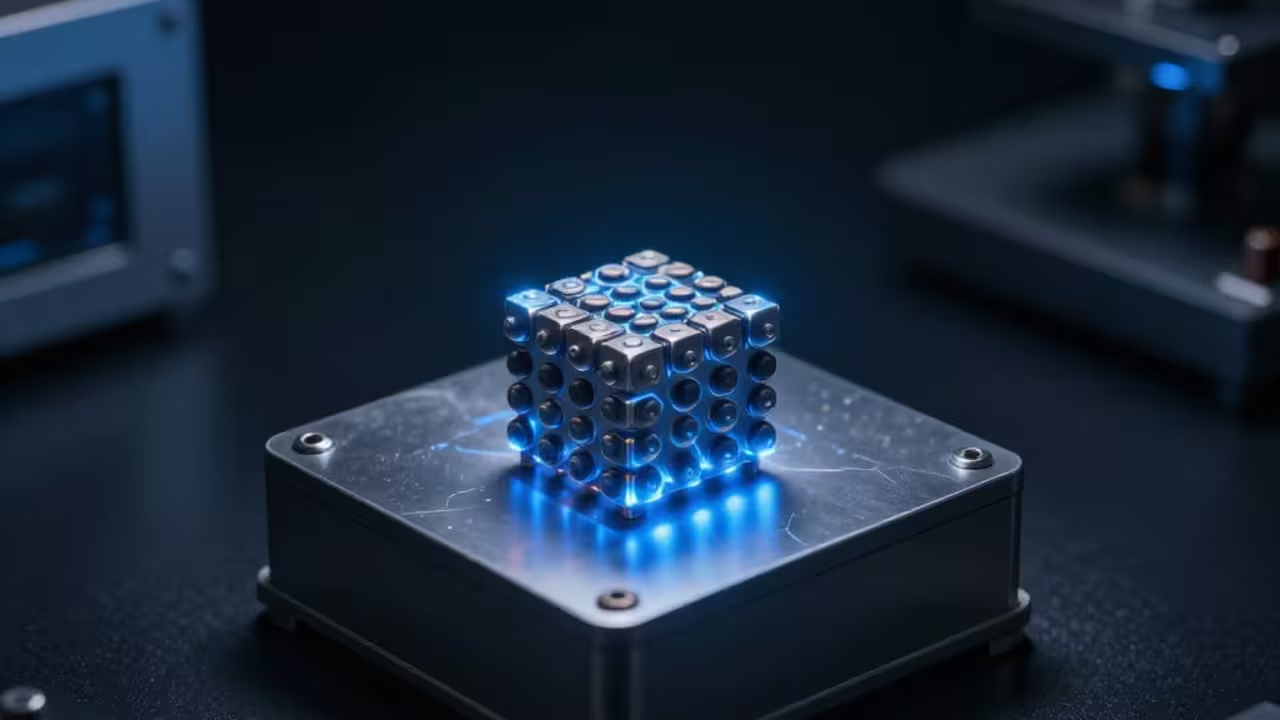
Advances in qubit coherence and quantum error correction are narrowing the distance between laboratory demonstration and deployable quantum technology. This brief surveys the landscape and examines what the shift means for applied research at INSTAR.
Coherence, error correction, and the practical threshold
For most of quantum computing’s short history, the challenge has been less whether quantum systems could outperform classical ones in principle and more whether they could do so in practice, given the fragility of quantum states. Maintaining qubit coherence—keeping quantum information intact long enough to perform useful computation—has been the central engineering constraint.
This convergence matters because quantum sensing, using quantum states to measure physical quantities with extraordinary precision, depends on the same underlying physics. Entanglement and superposition can enable sensors that resolve signals below the classical noise floor. As coherence times lengthen and error rates fall, the range of deployable applications expands alongside computational ones.
What practical quantum sensing enables
Potential applications span an unusually wide range. In medicine and biology, quantum-enhanced imaging could offer resolution and sensitivity not achievable with classical instrumentation. In navigation, timing, and geophysical measurement, quantum sensors promise accuracy that does not depend on external reference signals. In fundamental physics, precision sensing provides a route to testing predictions at energy scales and resolution levels beyond conventional instruments.
Each domain benefits not only from better sensors but from integrating sensing with real-time signal processing and adaptive control. The applied challenge is not simply to build better qubits; it is to build end-to-end systems that make quantum-derived information actionable.
INSTAR’s interest in applied quantum research
INSTAR’s applied research mandate connects naturally to the quantum-sensing trajectory. Work in physical sciences, materials science, and computational research intersects with questions quantum sensing makes newly tractable. We are interested in the engineering layer—the translation problems between proof-of-concept demonstrations and robust, deployable sensing systems—and in the cross-disciplinary collaborations that translation demands.
Quantum sensing is not yet a mature technology, which means foundational applied research done now can shape the field’s trajectory. INSTAR’s role is to contribute to that work and connect it to partner organizations and domains where better sensing can be useful soonest.